Security Blog
The latest news and insights from Google on security and safety on the Internet
Understanding differences between corporate and consumer Gmail threats
16. veljače 2017.
Posted by Ali Zand and Vijay Eranti, Anti-Abuse Research and Gmail Abuse
We are constantly working to protect our users, and quickly adapt to new online threats. This work never stops: every minute, we prevent over 10 million unsafe or unwanted emails from reaching Gmail users and threatening them with malicious attachments that infect a user’s machine if opened,
phishing messages
asking for banking or account details, and omnipresent
spam
. A cornerstone of our defense is understanding the pulse of the email threat landscape. This awareness helps us to anticipate and react faster to emerging attacks.
Today at RSA, we are sharing key insights about the diversity of threats to corporate Gmail inboxes. We’ve highlighted some of our key findings below; you can see our full presentation
here
. We’ve already incorporated these insights to help keep our G Suite users safe, and we hope that by exposing these nuances, security and abuse professionals everywhere can better understand their risk profile and customize their defenses accordingly.
How threats to corporate and consumer inboxes differ
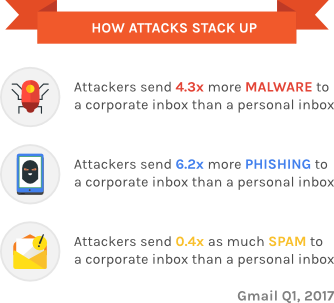
While spam may be the most common attack across all inboxes, did you know that malware and phishing are far more likely to target corporate users? Here’s a breakdown of how attacks stack up for corporate vs. personal inboxes:
Different threats to different types of organizations
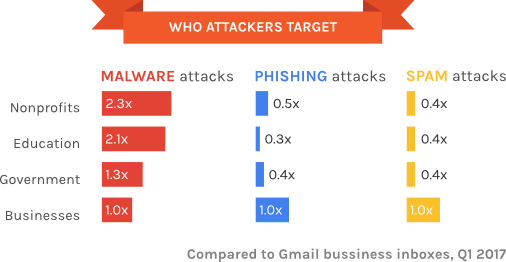
Attackers appear to choose targets based on multiple dimensions, such as the size and the type of the organization, its country of operation, and the organization’s sector of activity. Let’s look at an example of corporate users across businesses, nonprofits, government-related industries, and education services. If we consider business inboxes as a baseline, we find attackers are far more likely to target nonprofits with malware, while attackers are more likely to target businesses with phishing and spam.
These nuances go all the way down to the granularity of country and industry type. This shows how security and abuse professionals must tailor defenses based on their personalized threat model, where no single corporate user faces the same attacks.
Constant improvements to corporate Gmail protections
Research like this enables us to better protect our users. We are constantly innovating to better protect our users, and we've already implemented these findings into our G Suite protections. Additionally, we have implemented and rolled out several features that help our users stay safe against these ever-evolving threats.
The forefront of our defenses is a state-of-the-art email classifier that detects abusive
messages with 99.9% accuracy
.
To protect yourself from unsafe websites, make sure to heed
interstitial warnings
that alert you of potential phishing and malware attacks.
Use many layers of defense: we recommend using a
security key enforcement
(2-step verification) to thwart attackers from accessing your account in the event of a stolen password.
To ensure your email contents’ stays safe and secure in transit, use our
hosted S/MIME
feature.
Use our
TLS encryption indicator
, to ensure only the intended recipient can read your email.
We will never stop working to keep our users and their inboxes secure. To learn more about how we protect Gmail, check out this YouTube video that summarizes the lessons we learned while protecting Gmail users through the years.
Nema komentara :
Objavi komentar
Oznake
#sharethemicincyber
#supplychain #security #opensource
AI Security
android
android security
android tr
app security
big data
biometrics
blackhat
C++
chrome
chrome enterprise
chrome security
connected devices
CTF
diversity
encryption
federated learning
fuzzing
Gboard
google play
google play protect
hacking
interoperability
iot security
kubernetes
linux kernel
memory safety
Open Source
pha family highlights
pixel
privacy
private compute core
Rowhammer
rust
Security
security rewards program
sigstore
spyware
supply chain
targeted spyware
tensor
Titan M2
VDP
vulnerabilities
workshop
Archive
2026
tra
ožu
velj
sij
2025
pro
stu
lis
ruj
kol
srp
lip
svi
tra
ožu
velj
sij
2024
pro
stu
lis
ruj
kol
srp
lip
svi
tra
ožu
velj
sij
2023
pro
stu
lis
ruj
kol
srp
lip
svi
tra
ožu
velj
sij
2022
pro
stu
lis
ruj
kol
srp
lip
svi
tra
ožu
velj
sij
2021
pro
stu
lis
ruj
kol
srp
lip
svi
tra
ožu
velj
sij
2020
pro
stu
lis
ruj
kol
srp
lip
svi
tra
ožu
velj
sij
2019
pro
stu
lis
ruj
kol
srp
lip
svi
tra
ožu
velj
sij
2018
pro
stu
lis
ruj
kol
srp
lip
svi
tra
ožu
velj
sij
2017
pro
stu
lis
ruj
srp
lip
svi
tra
ožu
velj
sij
2016
pro
stu
lis
ruj
kol
srp
lip
svi
tra
ožu
velj
sij
2015
pro
stu
lis
ruj
kol
srp
lip
svi
tra
ožu
velj
sij
2014
pro
stu
lis
ruj
kol
srp
lip
tra
ožu
velj
sij
2013
pro
stu
lis
kol
lip
svi
tra
ožu
velj
sij
2012
pro
ruj
kol
lip
svi
tra
ožu
velj
sij
2011
pro
stu
lis
ruj
kol
srp
lip
svi
tra
ožu
velj
2010
stu
lis
ruj
kol
srp
svi
tra
ožu
2009
stu
lis
kol
srp
lip
ožu
2008
pro
stu
lis
kol
srp
svi
velj
2007
stu
lis
ruj
srp
lip
svi
Feed
Follow @google
Follow
Give us feedback in our
Product Forums
.



 Follow
Nema komentara :
Objavi komentar